

Delayed Auditory Feedback (DAF) is a software where a person hears their own voice with a slight delay. This effect occurs when spoken words are played back through a DAF device (such as the FluencyPods™), a mobile application or other forms of hardware. Originally created in the 1950s, DAF has been studied for its impact on speech fluency and speech patterns.
How Delayed Auditory Feedback Works
DAF manipulates the natural auditory loop between speaking and hearing, disrupting the expected timing of speech perception. When individuals speak under DAF conditions, they experience a delay, leading to changes in speech patterns, such as:
- Slowed Speech Rate – The delay forces speakers to elongate words, improving articulation and clarity.
- Increased Fluency in Stutterers – Research shows that individuals who stutter experience improved speech fluency when exposed to DAF.
Delayed Auditory Feedback Devices
Various DAF devices have been developed to assist individuals with speech disorders and improve speech fluency. These include:
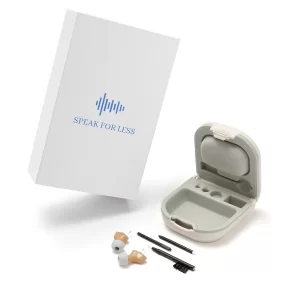
- Wearable DAF devices – Compact and portable, wearable DAF devices enable users to integrate delayed auditory feedback modifications into daily conversations.
- Mobile applications – Several smartphone apps offer adjustable DAF settings, allowing you to Try Before You Buy for a wearable device.
- DAF headsets and microphones – These external devices connect to computers or smartphones, providing real-time delayed feedback for speech training.
Applications of Delayed Auditory Feedback
Assistive Technology for Day to Day Life
DAF is widely used in anti-stuttering devices, helping individuals who stutter speak more fluently. By delaying their own voice, users naturally slow down their speech, which can reduce stuttering frequency and severity.
DAF Stuttering Therapy
DAF can be used as a standalone solution or as a complementary tool alongside speech therapy. While some users rely on it independently, others integrate it into their therapy sessions for added support. If you prefer a combined approach, you can use our DAF device, the FluencyPods™ with your speech-language pathologist (SLP) or one of our trusted partners.
How to see if Delayed Auditory Feedback is for you
Practicing with a DAF app
Using a DAF app can help individuals train their speech patterns. We recommend following the Try Before You Buy page on our website to see how DAF works for you.
Recording and Analyzing Speech Patterns
Recording speech under DAF conditions allows individuals to self-monitor their fluency and articulation. Reviewing recordings helps pinpoint areas needing improvement.
Conclusion
Delayed Auditory Feedback (DAF) can be highly beneficial for individuals who stutter, though its effectiveness varies from person to person. Some people are hyper-responders, experiencing significant fluency improvements, while others may notice a more subtle effect. At Speak for Less, we emphasize that DAF is not a cure—as no definitive cure for stuttering exists—but rather a valuable tool that can be integrated into daily life and speech therapy.
